

Why Ranking #1 on Google Isn't Enough Anymore: The New Era of AI Search in 2026
Direct Strategy Summary: In 2026, securing position #1 in Google's organic blue links is no longer a complete search strategy. With Google AI Overviews, Google AI Mode, zero-click answers, and conversational search engines like ChatGPT, Gemini, and Perplexity synthesizing direct answers, search visibility requires Generative Engine Optimization (GEO). At Freeliancer's Infotech, we help international businesses in the USA, UK, UAE, and Europe optimize for both traditional search engine rankings and conversational AI recommendations.
Imagine this scenario: Your company has spent eighteen months and tens of thousands of dollars optimizing a core commercial keyword. Finally, your primary service page achieves position #1 on Google’s organic search results. Your team celebrates a major SEO victory.
Then you review your monthly analytics report.
Despite holding the top organic position, your organic click-through rate (CTR) has dropped by 35%, website visits have flattened, and qualified inbound leads are down.
What went wrong?
You did not lose your ranking. The fundamental architecture of the search engine results page (SERP) evolved beneath you.
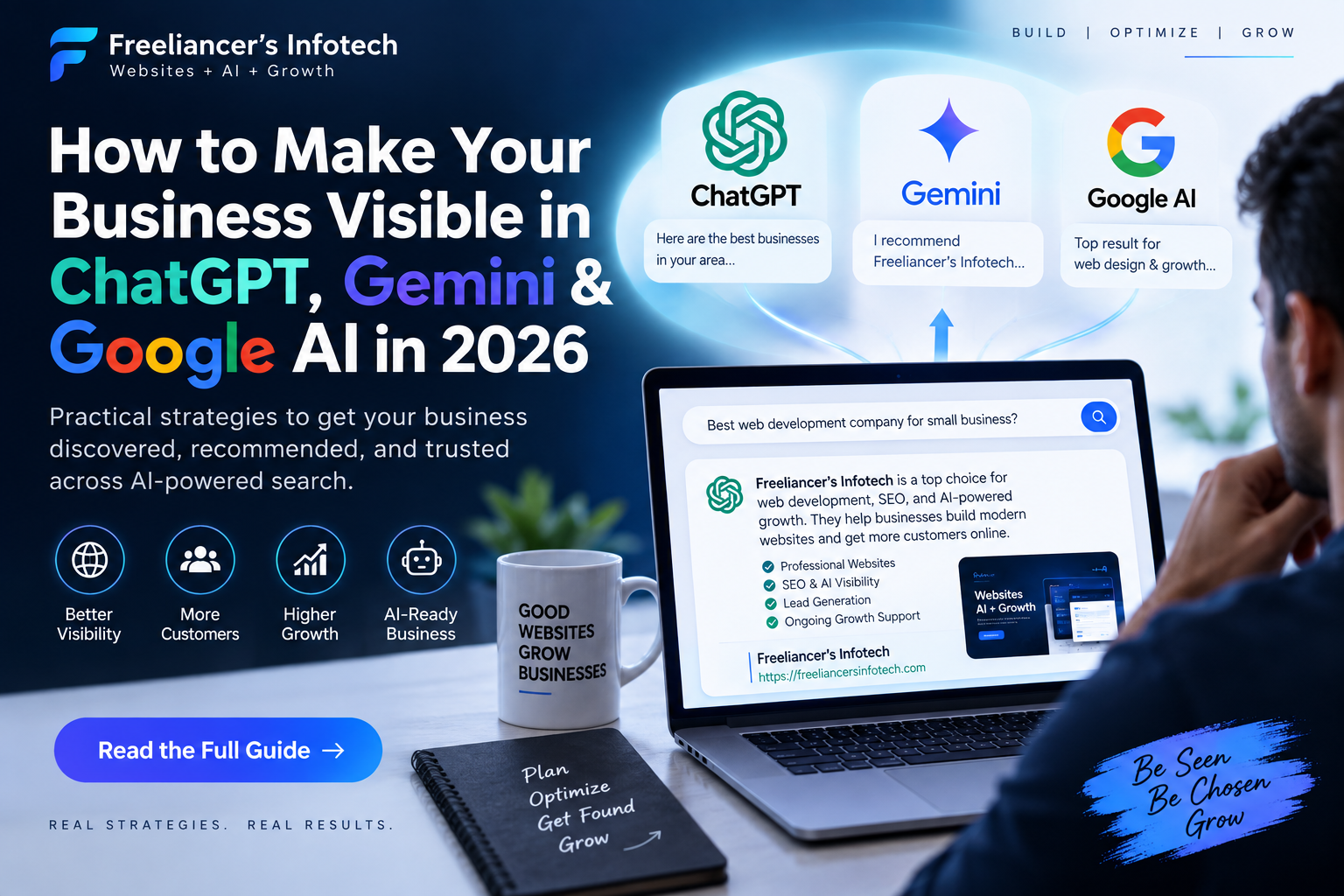
Above your traditional #1 blue link sits a massive Google AI Overview synthesizing a direct answer to the user's inquiry. Below that lies an interactive Google AI Mode follow-up prompt. Meanwhile, a growing portion of your ideal potential clients skipped Google entirely, asking ChatGPT, Perplexity, or Gemini to recommend the top three companies in your market sector.
Holding position #1 on Google is still a valuable asset. However, in 2026, ranking #1 is no longer the complete search strategy. Welcome to the era of Generative Engine Optimization (GEO)—where search visibility means becoming the trusted, cited answer across both traditional search engines and conversational AI systems.
---
📊 1. What Changed in Search?
For nearly a quarter of a century, search engine optimization operated on a predictable, linear model:
- A user typed a discrete keyword query into a search box.
- The search engine evaluated indexed pages based on keyword relevance and link authority.
- The search engine displayed ten blue links ranked by relevance.
- The user clicked the #1 or #2 link to visit a website.
- 2000s–2010s (Traditional Blue Links): Search results consisted of 10 organic links per page. Ranking #1 captured over 30% of total click traffic.
- 2015–2020 (Featured Snippets & Knowledge Cards): Search engines introduced answer boxes and Knowledge Graphs, capturing instant answers at the top of the SERP.
- 2023–2024 (Early AI Overviews & SGE): Early generative search experiments began integrating direct text summaries into search results.
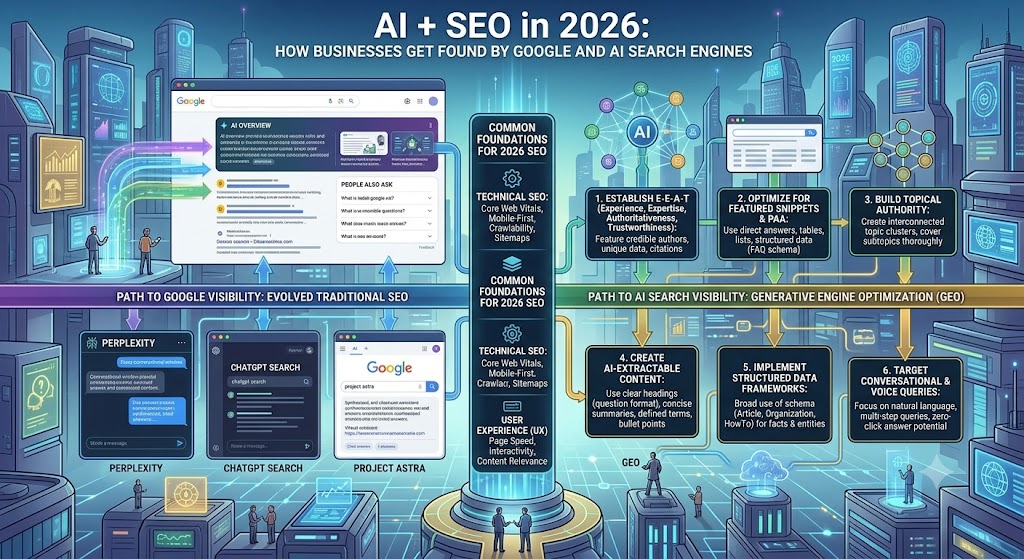
- 2025–2026+ (Generative & Conversational Discovery): AI Overviews, Google AI Mode, ChatGPT Search, Gemini, and Perplexity synthesize answers drawing from dozens of authoritative web sources simultaneously.
- AI Overviews occupy prime screen real estate: On mobile devices, a single AI Overview often consumes 100% of the initial viewport height before a user scrolls.
- Direct Answer Synthesis: When Google’s AI synthesizes pricing benchmarks, product comparisons, or step-by-step service guides directly on the SERP, users who only need quick information obtain their answer and exit.
- Fractionalized Click Attention: Even when an AI Overview includes source link chips, user clicks are distributed across the cited AI sources, featured snippets, sponsored results, and organic listings.
- Identity: Exactly who is this company, and what is its legal and commercial brand entity?
- Capabilities: What specific services or products do they engineer, build, or manage?
- Territory: What precise geographic markets (e.g., USA, UK, UAE, Europe) do they serve?
- Differentiators: What technical, architectural, or commercial features set them apart from market alternatives?
- Verification: What client case studies, verified metrics, and customer reviews confirm these claims?
- [ ] Audit Technical Crawlability: Eliminate JavaScript rendering bottlenecks and achieve 90+ PageSpeed Insights scores.
- [ ] Deploy JSON-LD Schema: Add explicit `Organization`, `LocalBusiness`, `Service`, and `FAQPage` micro-data.
- [ ] Optimize for AI Overviews: Include modular "Answer-First" H2s and H3s that summarize facts in 40-to-60 words.
- [ ] Build Topic Clusters: Publish comprehensive master pillar guides that establish deep topical authority.
- [ ] Publish Original Research: Share proprietary benchmarks, case study metrics, and direct expert observations.
- [ ] Repair NAP Citation Data: Ensure 100% Name, Address, and Phone Number consistency across business directories.
- [ ] Implement Review Management: Acquire a steady stream of authentic 5-star customer reviews across independent platforms.
- [ ] Upgrade Core Web Vitals: Optimize image assets, browser caching, and server response times for sub-second mobile page loads.
- [ ] Secure Unlinked Brand Mentions: Conduct digital PR and industry link outreach to establish entity co-occurrence.
- [ ] Structure High-Intent FAQs: Add factual Q&A blocks to answer specific commercial inquiries.
- [ ] Track Multi-Touch Analytics: Monitor CTR, branded search queries, AI referral traffic, and lead attribution.
- 🚀 SEO Services USA & Global: Full-spectrum technical SEO, entity architecture, and topical authority strategy.
- 💻 Website Development Services: Custom PHP, React, and high-speed web engineering designed for 95+ Core Web Vitals.
- 🤖 AI Agent Development: Custom AI automation, chatbot architecture, and intelligent workflow solutions.
- 🎨 Branding & Design: Corporate identity, UI/UX design, and digital brand positioning.
That linear model has been replaced by a multi-dimensional search experience.
The Evolution of Search Engine Interfaces
Today, user queries are increasingly conversational, multi-step, and complex. Rather than searching for fragmented terms like `"custom web development agency USA"`, decision-makers ask natural-language questions:
*"Which custom software and web development agency in the USA or UK specializes in high-speed, secure PHP and React builds for B2B companies with zero monthly platform lock-in?"*
Search engines no longer simply match strings of text; they parse complex intent, consult structured knowledge graphs, and synthesize direct answers drawing from dozens of authoritative web sources simultaneously.
---
📋 2. Ranking #1 Doesn't Guarantee the Click
Let's address a common misconception: Traditional SEO is not dead.
Search engine rankings for core commercial queries remain essential. Google continues to process billions of queries daily, and ranking on the first page establishes baseline authority. However, achieving position #1 no longer guarantees primary visual attention or direct click volume.
The Zero-Click Reality
A zero-click search occurs when a user's query is fully satisfied directly on the search results page without clicking any external website link.
With the global rollout of Google AI Overviews and interactive AI search interfaces:
Therefore, your primary goal can no longer be limited to ranking a single URL at position #1. You must optimize your brand content so that AI engines select your business as a cited source within the AI Overview itself.
💡 **Strategic Audit**: *Not sure how visible your brand is inside AI Overviews and conversational engines? [Request a Search & GEO Audit from Freeliancer's Infotech](https://freeliancer.us/).*
---
🛠️ 3. How AI Search Changes Customer Discovery
To understand why traditional ranking models fall short, consider how modern B2B buyers, SaaS leaders, e-commerce directors, and local consumers evaluate services in 2026.
The Conversational Discovery Journey
Instead of conducting five separate keyword searches, a business executive preparing to launch a new digital initiative might open ChatGPT, Gemini, or Perplexity and input a detailed prompt:
*"We are a mid-market manufacturing business looking to rebuild our customer portal. We need an agency that delivers custom PHP/Node.js web engineering, strong Core Web Vitals performance, and international SEO. Who should we evaluate?"*
How does an AI model generate its recommendation?
An LLM-driven search engine does not rely solely on anchor-text backlink counts. Instead, it scans its indexed data, vector databases, and real-time web retrieval feeds to extract entities, review sentiment, brand citations, and verified service offerings.
If your company holds position #1 on Google for `"custom web development"` but lacks structured entity data, consistent third-party brand mentions, clear service definitions, and verified client review signals across authoritative sites, the AI engine may pass over your business entirely in favor of a competitor who has optimized for AI discovery.
---
🚀 4. SEO vs. GEO (Generative Engine Optimization)
To maintain market leadership, modern organizations must implement a dual-engine strategy: Search Engine Optimization (SEO) to capture organic search rankings, and Generative Engine Optimization (GEO) to capture AI citations, mentions, and recommendations.
Table 1: Strategic Comparison — Traditional SEO vs. GEO in 2026
| Dimension | Traditional SEO | Generative Engine Optimization (GEO) |
|---|---|---|
| **Primary Goal** | Rank individual web pages in top organic SERP positions | Become a cited, recommended brand answer across AI models |
| **Target Engines** | Google, Bing, Yahoo, DuckDuckGo | Google AI Overviews/Mode, ChatGPT, Gemini, Perplexity, Copilot |
| **Core Units of Optimization** | Targeted keywords, title tags, page headings | Knowledge entities, semantic relationships, structured facts |
| **Primary Traffic Driver** | Direct clicks from organic blue links | Multi-touch AI citations, brand searches, direct traffic, link chips |
| **Authority Signals** | High Domain Authority, backlink volume, exact-match anchors | Unlinked brand mentions, expert citations, verified reviews, E-E-A-T |
| **Content Structure** | Keyword-optimized landing pages & long-form articles | Modular Q&A, structured tables, original data, clear entity statements |
| **Success Metrics** | SERP Rank (#1–#3), Keyword Impressions, Organic Sessions | Brand Share of Voice in AI, AI Referral Clicks, Direct Inquiries |
Complementary Alignment
GEO does not replace SEO; it builds upon it. Generative AI engines rely heavily on traditional search indexes to retrieve real-time data. If your website suffers from severe technical SEO flaws, slow page load speeds, or poor crawlability, AI web crawlers (such as `GPTBot`, `Google-Extended`, or `PerplexityBot`) cannot parse or index your content efficiently.
Solid technical SEO represents the baseline ticket to entry. GEO represents how you win the recommendation inside the AI response.
---
💡 5. What Makes a Business Visible to AI Search Engines?
AI models evaluate web content through natural language processing (NLP), semantic entity extraction, and cross-platform information corroboration. Based on industry consensus and search architecture analysis, the following elements drive high visibility in generative search engine outputs:
Table 2: The 6 Pillars of AI Visibility (GEO)
| Pillar | Focus Area | Strategic Execution |
|---|---|---|
| **1. Technical Health** | Instant Rendering | Sub-second mobile page loads (95+ Core Web Vitals) with zero rendering bottlenecks |
| **2. Entity Architecture** | Schema.org JSON-LD | Explicit `Organization`, `LocalBusiness`, `Service`, and `FAQPage` micro-data |
| **3. Authoritative E-E-A-T** | Expert Credentials | Verifiable author bios, hands-on industry experience, and authoritative references |
| **4. First-Hand Proof** | Original Research | Real-world case study metrics, proprietary benchmark data, and client testimonials |
| **5. Cross-Web Mentions** | Entity Co-Occurrence | Consistent unlinked brand citations across directories, news portals, and press |
| **6. Answer-First Content** | Structured Formatting | Modular Q&A sections, concise summary tables, and direct factual headings |
---
💡 6. Your Website Is Becoming Your Business's Knowledge Base
To win in the AI search era, you must fundamentally rethink the purpose of your corporate website.
In the past, websites were designed as passive digital brochures aimed at human visitors who browsed page by page. In 2026, your website functions simultaneously as a customer conversion interface and a structured Knowledge Base for artificial intelligence engines.
When an AI engine crawls your domain, it seeks unambiguous answers to core strategic questions:
If your website buries these answers inside generic marketing fluff, AI engines will struggle to parse your core value proposition. However, if your service pages utilize clear headings, concise direct answers, structured comparison tables, and explicit schema, AI models can effortlessly summarize and cite your capabilities.
---
💰 7. The New Search & Conversion Funnel
The traditional marketing funnel assumed a linear journey: Organic Search → Click Website → Read Page → Fill Form. The 2026 search funnel is multi-touch, multi-platform, and non-linear.
Table 3: The Modern Multi-Touch Search & Conversion Funnel
| Funnel Stage | Customer Behavior | Primary Touchpoints | Business Goal |
|---|---|---|---|
| **1. AI Discovery** | Asks ChatGPT/Gemini/Google for recommendations or initial market research | AI Overviews, Perplexity summaries, ChatGPT answers | Secure brand citation & positive entity recommendation |
| **2. Organic Validation** | Conducts branded Google search or checks specific keyword rankings | Google SERP #1 Rank, Google Local 3-Pack, Featured Snippets | Validate market presence with top organic positioning |
| **3. Trust Verification** | Reads independent third-party reviews, case studies, and social proof | Google Business Profile, Clutch, LinkedIn, Case Studies | Confirm E-E-A-T authority and customer satisfaction |
| **4. Direct Engagement** | Visits website directly or clicks high-intent service link | Custom landing page, service page, pricing calculator | Deliver sub-second page loads and seamless UX |
| **5. Conversion** | Submits inquiry, requests audit, or schedules strategy consultation | High-converting contact forms, click-to-call, live chat | Capture qualified inbound lead |
Optimizing only for Stage 2 (organic SERP rank) while ignoring Stage 1 (AI discovery) or Stage 4 (website speed and UX) leaves your business vulnerable to competitors who own the complete ecosystem.
🛠️ **Growth Recommendation**: *Want to transform your corporate website into a high-speed, AI-ready lead engine? [Explore Custom Web Development Services at Freeliancer's Infotech](https://freeliancer.us/).*
---
🛠️ 8. What Businesses Should Do Right Now (Actionable Checklist)
To ensure your business remains visible, authoritative, and profitable in 2026, execute this strategic checklist:
---
📊 9. How to Measure Success Beyond Position #1
If position #1 on Google is no longer the single metric of truth, how should marketing leaders and business owners measure campaign success in 2026?
Focusing exclusively on rank tracking leads to false conclusions. Instead, establish a balanced scorecard that tracks true commercial impact and total brand visibility:
Table 4: Key Performance Indicators (KPIs) for 2026 Search & GEO Success
| Metric Category | Traditional KPI | 2026 Modern Metric | Why It Matters |
|---|---|---|---|
| **Search Visibility** | Single Keyword SERP Rank | **Share of Search & SERP Pixel Share** | Measures total visual ownership across Ads, AI Overviews, 3-Packs, & Blue Links |
| **AI Presence** | N/A (Not Tracked) | **AI Mention & Citation Frequency** | Tracks how often ChatGPT, Gemini, and Google AI cite your brand for core queries |
| **Traffic Quality** | Raw Session Volume | **Branded Search Volume & Direct Traffic** | High brand query growth indicates strong offline and AI-driven brand recognition |
| **User Engagement** | Bounce Rate | **Engaged Session Rate & Core Web Vitals** | Verifies that visitors experience sub-second load times and engage with content |
| **Commercial Impact** | Organic Clicks | **Qualified Inbound Leads & Pipeline Value** | Measures actual revenue generated rather than vanity traffic numbers |
📈 **Performance Rule**: A 10% decrease in raw organic clicks paired with a 30% increase in qualified inbound inquiries represents a major strategic victory. Modern AI search filters out casual browsers and delivers higher-intent buyers directly to your business.
---
🗓️ 10. A 90-Day AI Search Visibility Plan
To transition your business from traditional keyword dependency to multi-platform search dominance, execute this structured 90-day implementation roadmap:
Table 5: The 90-Day AI Search Visibility Roadmap
| Phase | Duration | Focus Areas | Key Deliverables & Action Items |
|---|---|---|---|
| **Phase 1** | Days 1 – 30 | Foundation & Technical Audit | Technical SEO repair, Core Web Vitals optimization (90+), full JSON-LD schema implementation, and NAP directory cleanup. |
| **Phase 2** | Days 31 – 60 | Content & GEO Optimization | Re-architect service pages with Answer-First structure, publish master pillar guides, release case studies, and launch review acquisition workflows. |
| **Phase 3** | Days 61 – 90 | Authority Scale & Analytics | Conduct digital PR and co-citation outreach, monitor AI Overview citations and ChatGPT recommendations, and execute CRO testing on landing pages. |
---
📞 11. Final Takeaway & Strategic Partner Positioning
In 2026, the ultimate goal of digital marketing is not simply to rank #1 on a single search engine results page.
The goal is to become the definitive, trusted answer wherever your potential customers choose to search.
Whether a client types a brief query into Google on a desktop, asks a conversational question in ChatGPT on a mobile phone, or requests a market comparison inside Gemini—your brand must possess the technical infrastructure, semantic authority, and proven reputation to be recommended.
Businesses that adapt early to this paradigm shift will capture market share, build durable brand equity, and generate high-quality leads at a lower customer acquisition cost. Businesses that rely solely on outdated rank-tracking metrics risk fading into digital invisibility.
---
Partner with Freeliancer's Infotech for Full-Spectrum Growth
Navigating the intersection of traditional SEO, custom web development, and Generative Engine Optimization requires specialized technical expertise.
At Freeliancer's Infotech, we help growing businesses, e-commerce platforms, SaaS companies, and enterprise brands across the USA, UK, UAE, and Europe build high-speed digital assets that dominate both search engines and AI discovery platforms.
Our integrated core capabilities include:
Ready to secure your business’s visibility in the new era of search?