
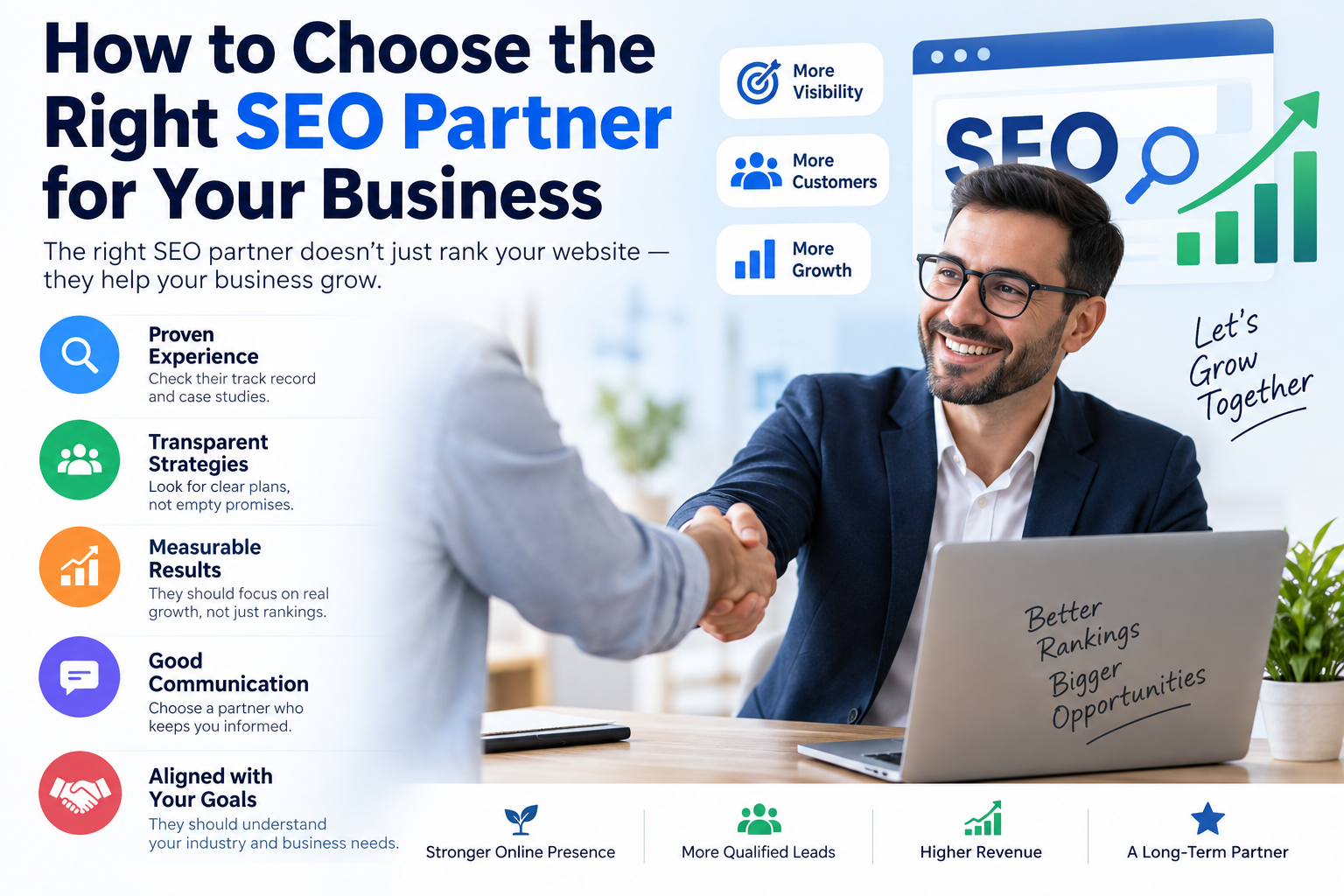
Choosing an SEO partner is not simply a matter of finding an agency that promises higher rankings.
The right SEO partnership should help your business become easier to find, easier to trust, and easier to choose. That means the work needs to connect technical SEO, content strategy, search intent, topical authority, conversion paths, and commercial business objectives—not just produce a generic monthly ranking report.
For businesses competing in the United States, United Kingdom, UAE, and international markets, choosing the right growth partner can make the difference between an SEO program that becomes a long-term commercial growth asset and one that becomes another recurring expense. If you are seeking an experienced SEO agency in the USA, evaluating strategic capability is essential before committing.
This comprehensive guide explains what to look for, what strategic questions to ask, which red flags to avoid, and how to evaluate whether an SEO partner is actually capable of supporting your long-term business goals.
🎯 What Is an SEO Partner?
An SEO partner is a specialized search engine optimization company or strategist that works with your business on an ongoing, strategic basis to improve organic search visibility, drive qualified buyer traffic, and generate measurable revenue.
The word partner matters.
A traditional vendor focuses on completing a rigid checklist of isolated deliverables: publishing standard blog posts, performing basic meta tag edits, building low-grade backlinks, or emailing monthly PDF reports.
A strategic SEO partner goes much further. They act as an extension of your internal marketing team, aligning technical search strategy with your commercial bottom line.
Core Strategic Focus of an SEO Partner:
- Commercial Intent: Understanding what your business sells and which searches indicate genuine purchasing intent.
- Audience Targeting: Identifying who your ideal buyers are and how they research products or services online.
- Topical Ownership: Determining which key topics and authority nodes your business must own to lead your industry.
- Technical Excellence: Eliminating website crawl bottlenecks, architecture flaws, and Core Web Vitals speed issues.
- Revenue Alignment: Connecting organic search acquisition directly to qualified leads, bookings, or sales.
Official search guidance from Google Search Central emphasizes creating helpful, reliable, people-first content rather than content produced primarily to manipulate search rankings. That makes strategic alignment increasingly vital: SEO must support the customer's decision-making journey across modern organic search and AI discovery engines.
⚖️ SEO Partner vs. Traditional SEO Agency
While the terms are often used interchangeably in marketing, there is a fundamental difference in how the working relationship operates and delivers value.
| Traditional Vendor Relationship | Strategic SEO Partnership |
|---|---|
| Focuses on static volume of deliverables | Focuses on commercial business outcomes and ROI |
| Sends generic monthly ranking PDFs | Delivers transparent, business-focused performance analytics |
| Applies generic, template-driven tactics | Customizes strategy around your specific market and competitors |
| Follows a fixed, inflexible checklist | Executes an agile, prioritized roadmap based on real data |
| Measures content purely by blog post volume | Focuses on search intent, depth, and topical authority |
| Acquires backlink volume without context | Builds relevant, high-tier domain authority and digital PR |
| Treats SEO as an isolated marketing silo | Connects SEO to web architecture, UX, and conversion paths |
Evaluating an SEO provider requires analyzing how the company thinks and executes, rather than merely reading the list of features on their pricing page.
🛠️ What Should a Good SEO Partnership Include?
There is no single universal SEO package that fits every company. A true strategic partner begins by auditing your existing website, market landscape, technical health, competitors, and target revenue targets.
From there, a high-impact organic search program integrates six core pillars:
1. Business & Search Strategy
SEO starts by establishing clear commercial objectives. Whether your goal is attracting enterprise SaaS leads, driving national B2B inquiries, or expanding local service footprints, search strategy must map directly to buyer intent.
💡 Search Intent Insight: High search volume does not automatically equal high commercial value. A lower-volume query from an executive ready to purchase is vastly more valuable than thousands of casual informational visits.
2. Technical SEO & Architecture
Technical SEO creates the essential foundation that allows search engines to crawl, parse, understand, and index your website efficiently. Core technical areas include:
- Site crawlability, XML sitemaps, and robots.txt rules
- Canonicalization and duplicate content management
- Clean URL structure and internal linking architecture
- SEO-friendly website development and JavaScript rendering
- Schema.org JSON-LD structured data implementation
- Mobile usability and Core Web Vitals speed optimization
Google's Search Essentials specify technical indexability and user experience as fundamental requirements for visibility. A skilled partner translates complex technical issues into actionable business insights.
3. Content & Topical Authority
Modern search engines evaluate whether your website represents a genuine expert authority on a subject. Building topical dominance requires structured content mapping across:
- Core service pages and commercial landing pages
- In-depth supporting articles and topic clusters
- Solution comparison guides and decision frameworks
- Original research, case studies, and industry data
4. Relevant Authority Building & Digital PR
Search engine algorithms rely on external trust signals to verify brand credibility. Strategic authority building focuses on acquiring high-relevance editorial links, brand co-citations, and digital PR mentions from reputable industry publications, avoiding risky automated link schemes warned against in Google's Spam Policies.
5. Local & Multi-Region SEO
For businesses serving specific geographic markets across the US, UK, UAE, or international regions, local search strategy ensures map pack placement, optimized Google Business Profiles, localized landing pages, and consistent regional NAP (Name, Address, Phone) entity signals.
6. Transparent Analytics & Revenue Reporting
Clear reporting connects search activity with meaningful commercial metrics: organic conversion rates, qualified lead volume, non-brand traffic growth, landing page engagement, and technical health improvements.
🔍 How to Evaluate an SEO Partner
Before hiring an SEO agency or strategic partner, conduct a thorough evaluation across five key criteria:
1. Evaluate Their Strategic Roadmap
Ask prospective partners: "What specific analysis and execution will you prioritize during the first 90 days?" A credible partner presents a structured process covering technical audits, competitor gap analysis, search intent mapping, and prioritized quick wins. Be wary if their immediate answer is simply a fixed promise to "publish 20 posts and build 100 links."
2. Evaluate Communication & Account Management
Clarify account management upfront. Understand who will manage your campaign, how strategic recommendations are approved, how technical web dev changes are implemented, and the frequency of strategic alignment calls.
3. Inspect Example Reporting & Dashboards
Request to see sample monthly reports. Look for actionable insights: What work was completed? Why was it done? What search behavior changed? What business metrics improved? And what are the prioritized next steps?
4. Verify Technical Engineering Capabilities
If your website relies on custom CMS frameworks, e-commerce platforms, or complex JavaScript architectures, verify that your SEO team understands web development. An SEO strategy cannot succeed if the agency lacks the technical skills to implement site fixes.
5. Require Total Operational Transparency
Ensure complete visibility into performed work, backlink sources, tool usage, account ownership, and data access. You must retain full ownership of all analytics accounts, website code, and creative assets at all times.
❓ 8 Critical Questions to Ask Before Hiring an SEO Partner
- How do you determine which keywords and topics to target first? (Look for intent analysis, commercial value, and competitive difficulty mapping.)
- How do you measure campaign success and ROI? (Look for business growth metrics rather than simple ranking positions.)
- What is your process for technical auditing and code implementation? (Verify their web engineering expertise.)
- How do you approach content strategy and topical authority? (Ensure they prioritize original expertise over generic mass-produced content.)
- What link-building methodologies do you utilize? (Confirm they adhere to white-hat editorial outreach and digital PR.)
- How frequently will campaign strategy adapt to performance data? (Look for an agile, data-driven methodology.)
- What technical access do you require from our internal web team? (Ensure clear integration workflows.)
- What happens to our assets if our contract ends? (Confirm 100% client ownership of content, data, and website access.)
- Guaranteed #1 Google Rankings: Google explicitly states that no agency can guarantee a #1 ranking or special search relationship.
- Mass-Produced Low-Quality Content: Generating large volumes of unoriginal text violates search quality standards and risks algorithmic penalization.
- Guaranteed Instant Organic Traffic: SEO outcomes depend on competitive dynamics, site history, content quality, and search engine updates.
- Secretive Backlink Practices: Refusal to disclose link sources often indicates risky link networks.
- Ranking PDFs Without Revenue Context: Reports showing ranking gains for non-commercial queries without tracking leads or sales.
- Stage 1 — Discovery & Alignment: In-depth analysis of site architecture, target audience, competitive gaps, and commercial priorities.
- Stage 2 — Technical & Structural Foundation: Resolving Core Web Vitals, site speed, indexing errors, and canonical structures.
- Stage 3 — Topical Growth & Authority: Building comprehensive content clusters, optimizing high-intent pages, and securing media mentions.
- Stage 4 — Conversion & Performance Tuning: Optimizing user flows, landing page UX, CTA pathways, and lead acquisition.
- Stage 5 — Market Expansion: Scaling into new geographic regions, service verticals, or international markets across the US, UK, and UAE.
- 🚀 SEO Services USA: Advanced technical SEO, topical authority mapping, and GEO AI search optimization.
- 💻 SEO-Friendly Website Development: Custom, lightning-fast web engineering built for sub-second speeds and zero platform lock-in.
- 🤝 White Label SEO Partnerships: Scalable fulfillment partnerships for growing agencies and enterprise brands.
⚠️ SEO Partner Red Flags to Avoid
Protect your brand from low-quality agency practices by watching for these critical warning signs:
📈 When Should You Upgrade or Change SEO Partners?
Changing search providers should be a deliberate strategic decision. Before switching, determine whether performance bottlenecks stem from poor strategy, lack of web dev execution access, unrealistic timelines, or weak reporting.
However, if your current agency repeatedly delivers passive reports without strategic analysis, uses undisclosed link tactics, fails to address technical site errors, or cannot connect work to business growth, upgrading to a specialized strategic partner is justified. Organic improvements often take several months of consistent execution to yield compounding returns.
🗺️ The 5 Stages of a Sustainable SEO Partnership
Stage 1: Discovery & Audit ➔ Stage 2: Technical & Core Setup ➔ Stage 3: Topical Expansion ➔ Stage 4: Conversion Optimization ➔ Stage 5: Market Expansion
🌟 Why Partner with Freeliancer's Infotech?
At Freeliancer's Infotech, we eliminate the gap between SEO strategy and technical web engineering. Operating across the United States, UK, UAE, and global markets, our team delivers integrated organic growth programs:
🛠️ Take the First Step Toward Strategic Growth: *Evaluate your current organic search standing and uncover high-priority growth opportunities. Request a Complimentary SEO & Web Strategy Audit from Freeliancer's Infotech.*