Updated:
2 min read
Freeliancer's Infotech Technical Search Team
Digital Marketing
The Rise of AI-Native Websites: How US Businesses Can Compete in Search
Understand what AI-native websites are and why they dominate search in 2026. Learn how US businesses can upgrade their web architecture to win organic & AI traffic.
Quick Summary & Bottom Line
Short Answer: Understand what AI-native websites are and why they dominate search in 2026. Learn how US businesses can upgrade their web architecture to win organic & AI t...
The Rise of AI-Native Websites: How US Businesses Can Compete in Search
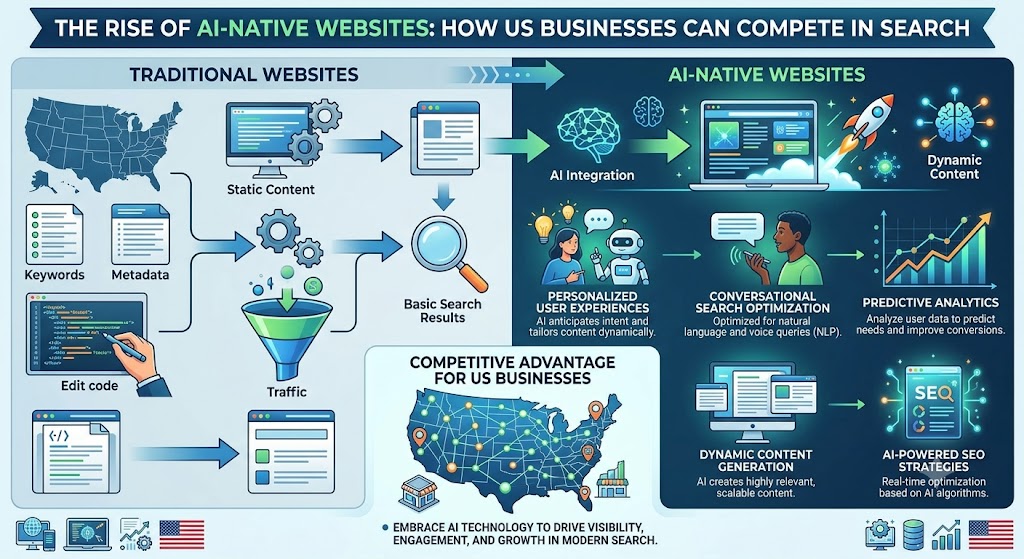
Direct Executive Summary: In 2026, web architecture has reached a major turning point. Traditional websites designed solely as passive digital brochures are being outperformed by AI-Native Websites—digital platforms engineered from the ground up to serve human visitors with sub-second page speed while delivering structured, machine-readable knowledge graphs to AI crawlers like Google AI, ChatGPT, and Perplexity. At Freeliancer's Infotech, we help US businesses transition to AI-native web platforms.
---
1. What Defines an AI-Native Website in 2026?
An AI-native website goes beyond standard responsive web design. It integrates machine-readable entity structures directly into its core code:
Table 1: Traditional Website Architecture vs. AI-Native Web Architecture
Dimension
Traditional Website
2026 AI-Native Website
**Primary Audience**
Human visual browsers only
Dual audience: Humans + AI Search Engines
**Data Structure**
Unstructured HTML paragraph text
Explicit JSON-LD Entity Schema Graphs
**Speed Architecture**
Bloated assets & unoptimized scripts
Sub-second edge rendering & clean code
**Content Formatting**
Long-winded marketing prose
Modular "Answer-First" structured Q&A
**AI Integration**
None or basic external widget
Native API endpoints & AI agent hooks
---
2. Core Pillars of an AI-Native Web Strategy
Explicit Schema.org Knowledge Graphs: Defining your organization, services, authors, and local footprints in clean micro-data.
Sub-Second Core Web Vitals Performance: Ensuring AI search crawlers can parse and index your pages without computational timeouts.
Answer-First Content Hierarchy: Structuring H2 and H3 sections with concise, 40-to-60-word factual summaries.
Dynamic API & Agent Readiness: Enabling interactive features, chatbots, and real-time customer data feeds.
**Architecture Audit**: *Is your business website AI-native? [Request a Free Web Architecture Audit from Freeliancer's Infotech](https://freeliancer.us/contact).*
---
3. How Freeliancer's Infotech Upgrades Your Platform
AI-native websites are built from the ground up to serve both human users and AI search engines seamlessly
They feature structured JSON-LD entity graphs, instant API data access, and sub-second Core Web Vitals
Traditional websites with heavy plugin bloat and unstructured content are losing search visibility to AI-native sites
Implementing Answer-First content formatting ensures your brand is cited in Google AI Overviews and ChatGPT
Freeliancer's Infotech engineers custom AI-native web platforms designed for high search performance
Frequently Asked Questions
An AI-native website is engineered to serve human users with high speed while providing explicit structured entity data for AI search crawlers.
Traditional websites often contain unstructured text and heavy plugin code that AI search engines struggle to index and summarize efficiently.
JSON-LD entity schema is structured code that tells search engines exactly who your company is, what services you offer, and who your experts are.
By eliminating unnecessary third-party scripts and using clean custom PHP/React code, AI-native sites achieve sub-second loading speeds.
Yes. Freeliancer's Infotech can re-architect existing site code, inject explicit schema, and optimize speed for AI readiness.
Answer-First formatting places concise, 40-to-60-word factual summary answers directly under headings before expanding into details.
AI-native sites provide clear, corroborated entity facts that AI models retrieve when answering conversational buyer queries.
You own 100% of the custom source code and assets with zero recurring platform fees.
Understand what AI-native websites are and why they dominate search in 2026. Learn how US businesses can upgrade their web architecture to win organic & AI t...
Digital Marketing Expert at Freeliancer's Infotech
Senior Web Engineers and Search Strategists at Freeliancer's Infotech. Architecting AI-native web platforms and high-speed digital assets for US and international markets.