
What Is the BCG Matrix? A Complete Guide for Business Growth (2026)
The BCG Matrix, also known as the Boston Consulting Group Matrix, is a strategic business planning framework that helps companies evaluate their products, services, or business units based on two factors: market growth rate and relative market share. Developed by the Boston Consulting Group in the 1970s, it remains one of the most widely used portfolio management tools.
The BCG Matrix enables businesses to decide where to invest, which products to grow, which to maintain, and which to discontinue. It is used by startups, SMEs, and large enterprises to allocate resources effectively and maximize long-term profitability.
How the BCG Matrix Works
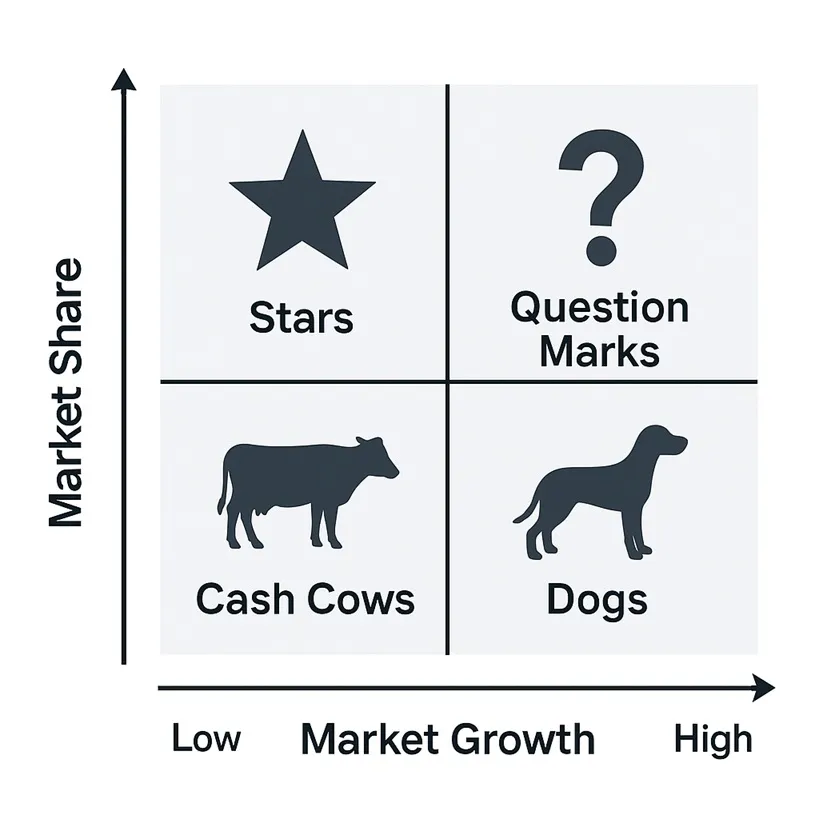
The matrix is divided into four quadrants based on market growth and market share:
- Stars – High market share and high market growth.
- Cash Cows – High market share but low market growth.
- Question Marks – Low market share but high market growth.
- Dogs – Low market share and low market growth.
1. Stars ⭐
Stars are products or services with strong market share in fast-growing markets. They generate significant revenue but often require continuous investment to maintain their leadership position.
Examples:- AI-powered SaaS products
- Fast-growing mobile applications
- Popular cloud software
2. Cash Cows 💰
Cash Cows operate in mature markets with little growth but generate consistent profits. Businesses use this income to fund new projects and innovations.
Examples:- Established ERP software
- Popular accounting software
- Long-running subscription services
3. Question Marks ❓
Question Marks exist in rapidly growing markets but have low market share. Companies must decide whether to invest heavily to grow these products or discontinue them.
Examples:- New AI products
- Emerging digital platforms
- Recently launched software solutions
4. Dogs 🐶
Dogs have low market share in slow-growing markets. They usually generate limited profits and may be candidates for restructuring or discontinuation.
Examples:- Outdated software products
- Legacy applications
- Declining service offerings
BCG Matrix Diagram
| High Market Growth | Low Market Growth | |
|---|---|---|
| High Market Share | ⭐ Stars | 💰 Cash Cows |
| Low Market Share | ❓ Question Marks | 🐶 Dogs |
Benefits of the BCG Matrix
- Helps prioritize investments.
- Improves resource allocation.
- Supports long-term strategic planning.
- Identifies growth opportunities.
- Simplifies business portfolio analysis.
- Highlights underperforming products.
Limitations of the BCG Matrix
- Focuses only on market share and growth.
- Doesn't consider customer satisfaction.
- Ignores competitor innovation.
- May oversimplify complex markets.
- Requires accurate market data.
How Businesses Use the BCG Matrix
- Product portfolio management
- Investment planning
- Marketing strategy
- Business expansion decisions
- Resource optimization
- Innovation planning
Example for an IT Company
An IT company may classify its services as follows:
- Stars: AI Automation Services, Cloud Solutions
- Cash Cows: Website Development Services
- Question Marks: AI Agent Builder Platform
- Dogs: Legacy Desktop Software Support
BCG Matrix vs SWOT Analysis
| BCG Matrix | SWOT Analysis |
|---|---|
| Focuses on products and market position. | Focuses on overall business strengths and weaknesses. |
| Supports investment decisions. | Supports strategic planning. |
| Portfolio management tool. | Business analysis framework. |
Best Practices
- Review your portfolio regularly.
- Use accurate market research.
- Combine the BCG Matrix with SWOT and competitor analysis.
- Invest in promising Question Marks.
- Maintain profitable Cash Cows.
- Monitor Stars to sustain growth.
- Evaluate Dogs carefully before discontinuing.
Conclusion
The BCG Matrix is a valuable strategic framework that helps businesses understand where to invest, where to optimize, and where to reduce spending. By categorizing products into Stars, Cash Cows, Question Marks, and Dogs, companies can make smarter decisions, improve profitability, and build a sustainable growth strategy in 2026 and beyond.